Linear Algebra and Its Applications, Review Exercise 1.11

Review exercise 1.11. Suppose E is a 2 by 2 matrix that adds the first equation of a linear system to the second equation. What is E^2? E^8? 8E?

Answer: Since E adds the first equation to the second, we have

E = \begin{bmatrix} 1&0 \\ 1&1 \end{bmatrix}

We then have

E^2 = \begin{bmatrix} 1&0 \\ 1&1 \end{bmatrix} \begin{bmatrix} 1&0 \\ 1&1 \end{bmatrix} = \begin{bmatrix} 1&0 \\ 2&1 \end{bmatrix}

and

E^4 = E^2 E^2 = \begin{bmatrix} 1&0 \\ 2&1 \end{bmatrix} \begin{bmatrix} 1&0 \\ 2&1 \end{bmatrix} = \begin{bmatrix} 1&0 \\ 4&1 \end{bmatrix}

so that

E^8 = E^4 E^4 = \begin{bmatrix} 1&0 \\ 4&1 \end{bmatrix} \begin{bmatrix} 1&0 \\ 4&1 \end{bmatrix} = \begin{bmatrix} 1&0 \\ 8&1 \end{bmatrix}

In general if for some k \ge 1 we have

E^k = \begin{bmatrix} 1&0 \\ k&1 \end{bmatrix}

then for k+1 we have

E^{k+1} = E E^k = \begin{bmatrix} 1&0 \\ 1&1 \end{bmatrix} \begin{bmatrix} 1&0 \\ k&1 \end{bmatrix} = \begin{bmatrix} 1&0 \\ k+1&1 \end{bmatrix}

Since for k = 1 we have

E^1 = E = \begin{bmatrix} 1&0 \\ 1&1 \end{bmatrix}

by induction for all n \ge 1 we have

E^n = \begin{bmatrix} 1&0 \\ n&1 \end{bmatrix}

Finally, we have

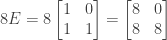
8E = 8 \begin{bmatrix} 1&0 \\ 1&1 \end{bmatrix} = \begin{bmatrix} 8&0 \\ 8&8 \end{bmatrix}

NOTE: This continues a series of posts containing worked out exercises from the (out of print) book Linear Algebra and Its Applications, Third Edition by Gilbert Strang.

If you find these posts useful I encourage you to also check out the more current Linear Algebra and Its Applications, Fourth Edition, Dr Strang’s introductory textbook Introduction to Linear Algebra, Fourth Edition and the accompanying free online course, and Dr Strang’s other books.

This entry was posted in linear algebra. Bookmark the permalink.

Leave a comment