Linear Algebra and Its Applications, Review Exercise 1.16

Review exercise 1.16. Given the following system of equations:

\setlength\arraycolsep{0.2em}\begin{array}{rcrcr} kx&+&y&=&1 \\ x&+&ky&=&1 \end{array}

what must k be for the system to have no solution? One solution? An infinite number of solutions?

Answer: If k = 0 then the system reduces to

\setlength\arraycolsep{0.2em}\begin{array}{rcrcr} &&y&=&1 \\ x&&&=&1 \end{array}

for which x = 1 and y = 1 is (obviously) a solution.

If k \ne 0 then we can multiply the first equation by 1/k and subtract it from the second equation to obtain the following system:

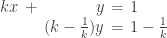
\setlength\arraycolsep{0.2em}\begin{array}{rcrcl} kx&+&y&=&1 \\ &&(k - \frac{1}{k})y&=&1 - \frac{1}{k} \end{array}

If k = 1 then this reduces to

\setlength\arraycolsep{0.2em}\begin{array}{rcrcl} 1 \cdot x&+&y&=&1 \\ &&(1 - \frac{1}{1})y&=&1 - \frac{1}{1} \end{array} \rightarrow \begin{array}{rcrcl} x&+&y&=&1 \\ &&0&=&0 \end{array}

This system has an infinite number of solutions, namely any value of (x, y) for which y = -x + 1.

If k \ne 0 and k \ne 1 then we can solve for y as follows:

y = (1 - \frac{1}{k}) / (k - \frac{1}{k}) = k (1 - \frac{1}{k}) / k(k - \frac{1}{k})

= (k - 1) / (k^2 - 1) = (k - 1) / (k - 1)(k + 1) = \frac{1}{k+1}

We then solve for x as follows:

kx = 1 - y = 1 - \frac{1}{k+1} = \frac{k+1}{k+1} - \frac{1}{k+1}

= \frac{k+1-1}{k+1} = \frac{k}{k+1}

\rightarrow x = \frac{1}{k} \frac{k}{k+1} = \frac{1}{k+1}

So for k \ne 0 and k \ne 1 the system has the unique solution (\frac{1}{k+1}, \frac{1}{k+1}). For example, for k = 2 the unique solution is (\frac{1}{2+1}, \frac{1}{2+1}) = (\frac{1}{3}, \frac{1}{3}).

Note that the solution for k = 0 was (1, 1) which matches that given by our formula: (\frac{1}{0+1}, \frac{1}{0+1}) = (1, 1). Also note that there is no value of k for which no solution exists.

Also note that there is no solution for k = -1, for which the solution (\frac{1}{k+1}, \frac{1}{k+1}) would require dividing by zero. In this case the system of equations is

\setlength\arraycolsep{0.2em}\begin{array}{rcrcr} -x&+&y&=&1 \\ x&-&y&=&1 \end{array} \rightarrow \begin{array}{rcrcr} x&-&y&=&-1 \\ x&-&y&=&1 \end{array}

and produces the contradiction -1 = 1.

NOTE: This continues a series of posts containing worked out exercises from the (out of print) book Linear Algebra and Its Applications, Third Edition by Gilbert Strang.

If you find these posts useful I encourage you to also check out the more current Linear Algebra and Its Applications, Fourth Edition, Dr Strang’s introductory textbook Introduction to Linear Algebra, Fourth Edition and the accompanying free online course, and Dr Strang’s other books.

This entry was posted in linear algebra. Bookmark the permalink.

2 Responses to Linear Algebra and Its Applications, Review Exercise 1.16

  1. Steve's avatar Steve says:

    I agree with the answers for one solution and infinitely many solutions, but I do not agree with your statement “that there is no value of k for which no solution exists.” If one sets k equal to -1, then x and y are undefined, for you are dividing by zero. Wouldn’t k = -1 produce no solution for the system?

Leave a comment