Linear Algebra and Its Applications, Review Exercise 1.18

Review exercise 1.18. Given the following matrix

A = \begin{bmatrix} 1&v_1&0&0 \\ 0&v_2&0&0 \\ 0&v_3&1&0 \\ 0&v_4&0&1 \end{bmatrix}

(a) Factor A into the form A = LU (if v_2 \ne 0).

(b) Show that A^{-1} exists and has the same form as A.

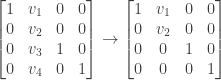
Answer: (a) We start elimination by subtracting v_3/v_2 times the second row from the third row (l_{32} = v_3/v_2) and subtracting v_4/v_2 times the second row from the fourth row (l_{32} = v_4/v_2) :

\begin{bmatrix} 1&v_1&0&0 \\ 0&v_2&0&0 \\ 0&v_3&1&0 \\ 0&v_4&0&1 \end{bmatrix} \rightarrow \begin{bmatrix} 1&v_1&0&0 \\ 0&v_2&0&0 \\ 0&0&1&0 \\ 0&0&0&1 \end{bmatrix}

This completes elimination, and we have

L = \begin{bmatrix} 1&0&0&0 \\ 0&1&0&0 \\ 0&v_3/v_2&1&0 \\ 0&v_4/v_2&0&1 \end{bmatrix} \quad \rm and \quad U = \begin{bmatrix} 1&v_1&0&0 \\ 0&v_2&0&0 \\ 0&0&1&0 \\ 0&0&0&1 \end{bmatrix}

so that

A = \begin{bmatrix} 1&0&0&0 \\ 0&1&0&0 \\ 0&v_3/v_2&1&0 \\ 0&v_4/v_2&0&1 \end{bmatrix} \begin{bmatrix} 1&v_1&0&0 \\ 0&v_2&0&0 \\ 0&0&1&0 \\ 0&0&0&1 \end{bmatrix} = LU

(b) We use Gauss-Jordan elimination, starting with the same elimination steps as above:

\begin{bmatrix} 1&v_1&0&0&\vline&1&0&0&0 \\ 0&v_2&0&0&\vline&0&1&0&0 \\ 0&v_3&1&0&\vline&0&0&1&0 \\ 0&v_4&0&1&\vline&0&0&0&1 \end{bmatrix} \rightarrow \begin{bmatrix} 1&v_1&0&0&\vline&1&0&0&0 \\ 0&v_2&0&0&\vline&0&1&0&0 \\ 0&0&1&0&\vline&0&-v_3/v_2&1&0 \\ 0&0&0&1&\vline&0&-v_4/v_2&0&1 \end{bmatrix}

This completes forward elimination, and we start backward elimination by multiplying v_1/v_2 times the second row and subtracting it from the first:

\begin{bmatrix} 1&v_1&0&0&\vline&1&0&0&0 \\ 0&v_2&0&0&\vline&0&1&0&0 \\ 0&0&1&0&\vline&0&-v_3/v_2&1&0 \\ 0&0&0&1&\vline&0&-v_4/v_2&0&1 \end{bmatrix} \rightarrow \begin{bmatrix} 1&0&0&0&\vline&1&-v_1/v_2&0&0 \\ 0&v_2&0&0&\vline&0&1&0&0 \\ 0&0&1&0&\vline&0&-v_3/v_2&1&0 \\ 0&0&0&1&\vline&0&-v_4/v_2&0&1 \end{bmatrix}

This completes backward elimination, and we divide the second row by v_2:

\begin{bmatrix} 1&0&0&0&\vline&1&-v_1/v_2&0&0 \\ 0&v_2&0&0&\vline&0&1&0&0 \\ 0&0&1&0&\vline&0&-v_3/v_2&1&0 \\ 0&0&0&1&\vline&0&-v_4/v_2&0&1 \end{bmatrix} \rightarrow \begin{bmatrix} 1&0&0&0&\vline&1&-v_1/v_2&0&0 \\ 0&1&0&0&\vline&0&1/v_2&0&0 \\ 0&0&1&0&\vline&0&-v_3/v_2&1&0 \\ 0&0&0&1&\vline&0&-v_4/v_2&0&1 \end{bmatrix}

We thus have

A^{-1} = \begin{bmatrix} 1&-v_1/v_2&0&0 \\ 0&1/v_2&0&0 \\ 0&-v_3/v_2&1&0 \\ 0&-v_4/v_2&0&1 \end{bmatrix}

with A^{-1} having the same form as A.

NOTE: This continues a series of posts containing worked out exercises from the (out of print) book Linear Algebra and Its Applications, Third Edition by Gilbert Strang.

If you find these posts useful I encourage you to also check out the more current Linear Algebra and Its Applications, Fourth Edition, Dr Strang’s introductory textbook Introduction to Linear Algebra, Fourth Edition and the accompanying free online course, and Dr Strang’s other books.

This entry was posted in linear algebra. Bookmark the permalink.

Leave a comment