Linear Algebra and Its Applications, exercise 1.2.9

Exercise 1.2.9. We can re-express the system of equations from 1.2.8 as follows:
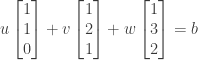
u \begin{bmatrix}1 \\ 1 \\ 0\end{bmatrix} + v \begin{bmatrix}1 \\ 2 \\ 1\end{bmatrix} + w \begin{bmatrix}1 \\ 3 \\ 2\end{bmatrix} = b

Demonstrate that the third column can be expressed as a linear combination of the first two columns, so that the three columns lie in the same plane. Then assume that b = (0, 0, 0) and categorize the solutions (u, v, w) for that special case.

Answer: We are looking for c_1 and c_2 such that

c_1 \begin{bmatrix}1 \\ 1 \\ 0\end{bmatrix} + c_2 \begin{bmatrix}1 \\ 2 \\ 1\end{bmatrix} = \begin{bmatrix}1 \\ 3 \\ 2\end{bmatrix}

Note that the last entry in the first column is 0, so that

c_1 \cdot 0 + c_2 \cdot 1 = 2 \Rightarrow c_2 = 2

From the first entry in each column we have

c_1 \cdot 1 + c_2 \cdot 1 = 1 \Rightarrow c_1 + 2 = 1 \Rightarrow c_1 = -1

Finally, from the second entry in each column we have

c_1 \cdot 1 + c_2 \cdot 2 = -1 \cdot 1 + 2 \cdot 2 = -1 + 4 = 3

So we have the third column as a linear combination of the first two columns:
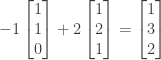
-1 \begin{bmatrix}1 \\ 1 \\ 0\end{bmatrix} + 2 \begin{bmatrix}1 \\ 2 \\ 1\end{bmatrix} = \begin{bmatrix}1 \\ 3 \\ 2\end{bmatrix}

Now assume b = (0, 0, 0) in the original system:
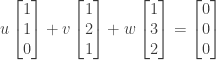
u \begin{bmatrix}1 \\ 1 \\ 0\end{bmatrix} + v \begin{bmatrix}1 \\ 2 \\ 1\end{bmatrix} + w \begin{bmatrix}1 \\ 3 \\ 2\end{bmatrix} = \begin{bmatrix}0 \\ 0 \\ 0\end{bmatrix}

From the equation above we have

-1 \begin{bmatrix}1 \\ 1 \\ 0\end{bmatrix} + 2 \begin{bmatrix}1 \\ 2 \\ 1\end{bmatrix} = \begin{bmatrix}1 \\ 3 \\ 2\end{bmatrix} \Rightarrow -1 \begin{bmatrix}1 \\ 1 \\ 0\end{bmatrix} + 2 \begin{bmatrix}1 \\ 2 \\ 1\end{bmatrix} - 1 \begin{bmatrix}1 \\ 3 \\ 2\end{bmatrix} = \begin{bmatrix}0 \\ 0 \\ 0\end{bmatrix}

So one solution for (u, v, w) is (-1, 2, -1). Another solution is (0, 0, 0). We can multiply the equation above by an arbitrary constant c and the right-hand side will remain zero, so the complete set of solutions is all vectors of the form c(-1, 2, -1), i.e., a line through the points (-1, 2, -1) and the origin.

NOTE: This continues a series of posts containing worked out exercises from the (out of print) book Linear Algebra and Its Applications, Third Edition by Gilbert Strang.

If you find these posts useful I encourage you to also check out the more current Linear Algebra and Its Applications, Fourth Edition, Dr Strang’s introductory textbook Introduction to Linear Algebra, Fourth Edition and the accompanying free online course, and Dr Strang’s other books.

Posted in linear algebra | Leave a comment

Linear Algebra and Its Applications, exercise 1.2.8

Exercise 1.2.8. We have the following system of three of equations in three unknowns:

\begin{array}{r} u + v + w = 2 \\ u + 2v + 3w = 1 \\ v + 2w = 0 \end{array}

Show that the system is singular by showing that there is a combination of the three equations that produces the contradiction 0 = 1. Find a right-hand side for which the system is nonsingular, and find one of its solutions.

Answer: We start by subtracting the second equation from the first in order to eliminate u:

\begin{array}{r} u + v + w = 2 \\ u + 2v + 3w = 1 \\ v + 2w = 0 \end{array} \Rightarrow \begin{array}{r} u + v + w - (u + 2v +3w) = 2 - 1 \\ v + 2w = 0 \end{array} \Rightarrow \begin{array}{r} -v -2w = 1 \\ v + 2w = 0 \end{array}

We then add the remaining two equations:

\begin{array}{r} -v -2w = 1 \\ v + 2w = 0 \end{array} \Rightarrow -v -2w + v + 2w = 1 + 0 \Rightarrow 0 = 1

Since we’ve derived the contradiction 0 = 1 there is no solution to the system, i.e., it is singular.

However, if the zero on the right-hand side of the third equation were changed to -1 then there would be no contradiction:

\begin{array}{r} u + v + w = 2 \\ u + 2v + 3w = 1 \\ v + 2w = -1 \end{array}

(The sequence of operations described above would instead generate the identity 1 = 1.)

In the above system we can discard the second equation as redundant, since it is equal to the sum of the first and third equations. We can solve the remaining system of equations by subtracting the third equation from the first:

\begin{array}{r} u + v + w = 2 \\ v + 2w = -1 \end{array} \Rightarrow \begin{array}{r} u + v + w - (v + 2w) = 2 - (-1) \\ v + 2w = 1 \end{array} \Rightarrow \begin{array}{r} u - w = 3 \\ v + 2w = -1 \end{array}

We can then solve for u and v in terms of w:

\begin{array}{r} u - w = 3 \\ v + 2w = -1 \end{array} \Rightarrow \begin{array}{l} u = w + 3 \\ v = -2w -1 \end{array}

For w = 0 we have u = 3 and v = -1, so (3, -1, 0) is a solution to this new system of equations.

UPDATE: Corrected the third equation in the original statement of the problem; thanks to joohyun for finding the error. Also corrected another error I found myself at the same time.

NOTE: This continues a series of posts containing worked out exercises from the (out of print) book Linear Algebra and Its Applications, Third Edition by Gilbert Strang.

If you find these posts useful I encourage you to also check out the more current Linear Algebra and Its Applications, Fourth Edition, Dr Strang’s introductory textbook Introduction to Linear Algebra, Fourth Edition and the accompanying free online course, and Dr Strang’s other books.

Posted in linear algebra | 2 Comments

Linear Algebra and Its Applications, exercise 1.2.7

Exercise 1.2.7. Start with equation (4) from p. 8 of the text:

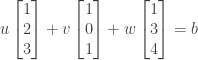
u \begin{bmatrix}1 \\ 2 \\ 3\end{bmatrix} + v \begin{bmatrix}1 \\ 0 \\ 1\end{bmatrix} + w \begin{bmatrix}1 \\ 3 \\ 4\end{bmatrix} = b

where a solution can be found for b = (2, 5, 7) and cannot be found for b = (2, 5, 6). Find two more values of b for which a solution can be found, and two more for which no solution is possible.

Answer: As noted in the text, the three columns (1, 2, 3), (1, 0, 1), and (1, 3, 4) lie in a plane, since three times (1, 2, 3) plus minus (1, 0, 1) equals twice (1, 3, 4). In other words, one of the three columns can be expressed as a linear combination of the other two. The value b = (2, 5, 7) is also in the same plane, being expressible as (1, 2, 3) plus (1, 3, 4).

So to find additional b for which a solution is possible, we can simply take any b in the same plane as the other vectors. One possibility is twice (2, 5, 7) or (4, 10, 14). Another is (1, 0, 1) plus (1, 3, 4) or (2, 3, 5).

We can then take those solutions and find values of b for which the equations cannot be solved, by looking for values of b not in the same plane as the previous vectors. One possibility is (4, 10, 15), another is (2, 3, 6).

UPDATE: Corrected error in first paragraph of answer; thanks to freaky4you for the fix!

NOTE: This continues a series of posts containing worked out exercises from the (out of print) book Linear Algebra and Its Applications, Third Edition by Gilbert Strang.

If you find these posts useful I encourage you to also check out the more current Linear Algebra and Its Applications, Fourth Edition, Dr Strang’s introductory textbook Introduction to Linear Algebra, Fourth Edition and the accompanying free online course, and Dr Strang’s other books.

Posted in linear algebra | 3 Comments

Linear Algebra and Its Applications, exercise 1.2.6

Exercise 1.2.6. Start with equation (4) from p. 8 of the text:

u \begin{bmatrix}1 \\ 2 \\ 3\end{bmatrix} + v \begin{bmatrix}1 \\ 0 \\ 1\end{bmatrix} + w \begin{bmatrix}1 \\ 3 \\ 4\end{bmatrix} = b

and assume that b = (2, 5, 7) (a value of b for which solutions can be found for u, v, and w). The text mentions two solutions, (1, 0, 1) and (4, -1, -1). What is another solution (u, v, w)?

Answer: Our task is to find one more solution to

u \begin{bmatrix}1 \\ 2 \\ 3\end{bmatrix} + v \begin{bmatrix}1 \\ 0 \\ 1\end{bmatrix} + w \begin{bmatrix}1 \\ 3 \\ 4\end{bmatrix} = \begin{bmatrix}2 \\ 5 \\ 7\end{bmatrix}

As noted in the text, the equation

u \begin{bmatrix}1 \\ 2 \\ 3\end{bmatrix} + v \begin{bmatrix}1 \\ 0 \\ 1\end{bmatrix} + w \begin{bmatrix}1 \\ 3 \\ 4\end{bmatrix} = \begin{bmatrix}0 \\ 0 \\ 0\end{bmatrix}

has the solution (3, -1, -2):

3 \begin{bmatrix}1 \\ 2 \\ 3\end{bmatrix} - \begin{bmatrix}1 \\ 0 \\ 1\end{bmatrix} - 2 \begin{bmatrix}1 \\ 3 \\ 4\end{bmatrix} = \begin{bmatrix}0 \\ 0 \\ 0\end{bmatrix}

We can then multiply each side of the equation by any constant c to obtain:

3c \begin{bmatrix}1 \\ 2 \\ 3\end{bmatrix} - c \begin{bmatrix}1 \\ 0 \\ 1\end{bmatrix} - 2c \begin{bmatrix}1 \\ 3 \\ 4\end{bmatrix} = c \begin{bmatrix}0 \\ 0 \\ 0\end{bmatrix} = \begin{bmatrix}0 \\ 0 \\ 0\end{bmatrix}

Since (1, 0, 1) is a solution to the original equation we have:

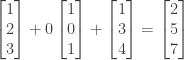
\begin{bmatrix}1 \\ 2 \\ 3\end{bmatrix} + 0 \begin{bmatrix}1 \\ 0 \\ 1\end{bmatrix} + \begin{bmatrix}1 \\ 3 \\ 4\end{bmatrix} = \begin{bmatrix}2 \\ 5 \\ 7\end{bmatrix}

Adding this equation to the previous one we obtain:

(3c + 1) \begin{bmatrix}1 \\ 2 \\ 3\end{bmatrix} + (-c) \begin{bmatrix}1 \\ 0 \\ 1\end{bmatrix} + (-2c + 1) \begin{bmatrix}1 \\ 3 \\ 4\end{bmatrix} = \begin{bmatrix}2 \\ 5 \\ 7\end{bmatrix}

Thus there are an infinite number of solutions of the form (3c + 1, -c, -2c + 1) where c is any real number. Setting c = 0 and c = 1 respectively gives the solutions (1, 0, 1) and (4, -1, -1) previously noted, while setting c = -1 gives the additional solution (-2, 1, 3) and setting c = 2 the additional solution (7, -2, -3).

NOTE: This continues a series of posts containing worked out exercises from the (out of print) book Linear Algebra and Its Applications, Third Edition by Gilbert Strang.

If you find these posts useful I encourage you to also check out the more current Linear Algebra and Its Applications, Fourth Edition, Dr Strang’s introductory textbook Introduction to Linear Algebra, Fourth Edition and the accompanying free online course, and Dr Strang’s other books.
Posted in linear algebra | Leave a comment

Linear Algebra and Its Applications, exercise 1.2.5

Exercise 1.2.5. The following three equations:

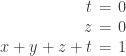
\setlength\arraycolsep{0.2em}\begin{array}{rcl} t&=&0 \\ z&=&0 \\ x + y + z + t&=&1 \end{array}

correspond to planes in 4-space (or space-time). Find two points on the line that is the intersection of the planes represented by the equations.

Answer: We substitute the values of t and z from the first two equations into the third:

x + y + z + t = 1 \Rightarrow x + y = 1

Values of x and y satisfying this equation include x = 1, y = 0 and x = 0, y = 1. Two points satisfying all three equations are thus (1, 0, 0, 0) and (0, 1, 0, 0).

NOTE: This continues a series of posts containing worked out exercises from the (out of print) book Linear Algebra and Its Applications, Third Edition by Gilbert Strang.

If you find these posts useful I encourage you to also check out the more current Linear Algebra and Its Applications, Fourth Edition, Dr Strang’s introductory textbook Introduction to Linear Algebra, Fourth Edition and the accompanying free online course, and Dr Strang’s other books.

Posted in linear algebra | 1 Comment

Linear Algebra and Its Applications, exercise 1.2.4

Exercise 1.2.4. For the following three equations:

\setlength\arraycolsep{0.2em}\begin{array}{rcrcl} x&+&2y&=&2 \\ x&-&y&=&2 \\ &&y&=&1 \end{array}

sketch the lines associated with the equation and determine whether the equations have a simultaneous solution. What about if the right-hand sides of all three equations were zero? Are there other right-hand sides for which a solution exists?

Answer: I’ll skip the sketch. Instead, let’s solve the first two equations above by subtracting the second equation from the first. This gives us the equation

(x + 2y) - (x - y) = 2 - 2 \Rightarrow 3y = 0 \Rightarrow y = 0

Substituting y = 0 into both equations gives x = 2. So the point (2, 0) is a solution to both equations and is the point where the lines corresponding to the first two equations meet. If we then add the third equation y = 1 it’s clear that there is no simultaneous solution for all three equations.

Now set the right-hand sides of all equations to zero:

\setlength\arraycolsep{0.2em}\begin{array}{rcrcl} x&+&2y&=&0 \\ x&-&y&=&0 \\ &&y&=&0 \end{array}

Substituting the value y = 0 into the first two equations gives x = 0. So the point (0, 0) is a solution to all three equations.

Do other solutions exist? Going back to the original equations, start with the third equation y = 1 and then solve for x in the second equation to get x = 3. Substituting x = 3 and y = 1 in the left hand side of the first equation gives

x + 2y = 3 + 2 \cdot 1 = 5

So the following equations

\setlength\arraycolsep{0.2em}\begin{array}{rcrcl} x&+&2y&=&5 \\ x&-&y&=&2 \\ &&y&=&1 \end{array}

have the unique solution (3, 1).

NOTE: This continues a series of posts containing worked out exercises from the (out of print) book Linear Algebra and Its Applications, Third Edition by Gilbert Strang.

If you find these posts useful I encourage you to also check out the more current Linear Algebra and Its Applications, Fourth Edition, Dr Strang’s introductory textbook Introduction to Linear Algebra, Fourth Edition and the accompanying free online course, and Dr Strang’s other books.

Posted in linear algebra | Leave a comment

Linear Algebra and Its Applications, exercise 1.2.3

Exercise 1.2.3. For the following three equations (in 4-space):

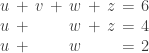
\setlength\arraycolsep{0.2em}\begin{array}{rrrrrrrrl} u&+&v&+&w&+&z&=&6 \\ u&+&&&w&+&z&=&4 \\ u&+&&&w&&&=&2 \end{array}

what is the intersection of the three planes described by the equations? If we add a fourth equation u = -1, describe the intersection of the plane associated with this equation with the previous three planes.

Answer: First, subtract (u + w) from both sides of the first two equations to obtain the following

\setlength\arraycolsep{0.2em}\begin{array}{rcl} v + z&=&6 - (u + w) \\ z&=&4 - (u + w) \\ u + w&=&2 \end{array} \Rightarrow \begin{array}{rcl} v&=&6 - z - (u + w) \\ z&=&4 - (u +  w) \\ u + w&=&2 \end{array}

Then substitute the value of (u + w) (from the third equation) into the first two equations:

\setlength\arraycolsep{0.2em}\begin{array}{rcl} v&=&4 - z \\ z&=&2 \\ u + w&=&2 \end{array}

Solve for w in the third equation, and substitute the value of z into the first equation:

\setlength\arraycolsep{0.2em}\begin{array}{rcl} v&=&2 \\ z&=&2 \\ w&=&-u + 2 \end{array}

Since v and z have constant values, this corresponds to a line in the u-w plane in 4-space.

If we also assume the equation u = -1 then we have w = 3 by virtue of the third equation. This means that the four planes (in 4-space) corresponding to the four equations intersect in the point (-1, 2, 3, 2).

NOTE: This continues a series of posts containing worked out exercises from the (out of print) book Linear Algebra and Its Applications, Third Edition by Gilbert Strang.

If you find these posts useful I encourage you to also check out the more current Linear Algebra and Its Applications, Fourth Edition, Dr Strang’s introductory textbook Introduction to Linear Algebra, Fourth Edition and the accompanying free online course, and Dr Strang’s other books.

Posted in linear algebra | Leave a comment

Linear Algebra and Its Applications, exercise 1.2.2

Exercise 1.2.2. Given the system of equations

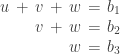
\setlength\arraycolsep{0.2em}\begin{array}{rrrrrrr} u&+&v&+&w&=&b_1 \\ &&v&+&w&=&b_2 \\ &&&&w&=&b_3 \end{array}

solve for u, v, and w, and then use the solution to find a linear combination of column vectors that equals the vector (b_1, b_2, b_3).

Answer: First, subtract the third equation from the other first two to get

\setlength\arraycolsep{0.2em}\begin{array}{rrrrrrl} u&+&v&&&=&b_1 - b_3 \\ &&v&&&=&b_2 - b_3 \\ &&&&w&=&b_3 \end{array}

Then subtract the second equation from the first to get

\setlength\arraycolsep{0.2em}\begin{array}{rcl} u&=&b_1 - b_2 \\ v&=&b_2 - b_3 \\ w&=&b_3 \end{array}

We can restate the original set of equations as

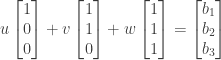
u\begin{bmatrix}1 \\ 0 \\ 0\end{bmatrix} + v\begin{bmatrix}1 \\ 1 \\ 0\end{bmatrix} + w\begin{bmatrix}1 \\ 1 \\ 1\end{bmatrix} = \begin{bmatrix}b_1 \\ b_2 \\ b_3\end{bmatrix}

and then substitute in the solutions for u, v, and w:

(b_1 - b_2)\begin{bmatrix}1 \\ 0 \\ 0\end{bmatrix} + (b_2 - b_3)\begin{bmatrix}1 \\ 1 \\ 0\end{bmatrix} + b_3\begin{bmatrix}1 \\ 1 \\ 1\end{bmatrix} = \begin{bmatrix}b_1 \\ b_2 \\ b_3\end{bmatrix}

This expresses the right-hand side as a linear combination of the vectors (1, 0, 0), (1, 1, 0), and (1, 1, 1).

NOTE: This begins a series of posts containing worked out exercises from the (out of print) book Linear Algebra and Its Applications, Third Edition by Gilbert Strang.

If you find these posts useful I encourage you to also check out the more current Linear Algebra and Its Applications, Fourth Edition, Dr Strang’s introductory textbook Introduction to Linear Algebra, Fourth Edition and the accompanying free online course, and Dr Strang’s other books.

Posted in linear algebra | 2 Comments

My math homework

Recently I’ve been interested in the problem of displaying mathematics on the web, so thought I’d try out the support on wordpress.com for LaTeX (or, more correctly, \LaTeX). And what better way to test it than to put my math homework on line?

For more background see the About page of this blog.

Posted in linear algebra | Leave a comment