Linear Algebra and Its Applications, Exercise 3.3.2

Exercise 3.3.2. We have the value b_1 = 1 at time t_1 = 1 and the value b_2 = 7 at time t_2 = 2. We wish to fit these values using a line constrained to go through the origin, i.e., with an equation of the form b = Dt. Solve the system using least squares and describe the best fit line.

Answer: In general we would fit a line of the form C + Dt = b; however since we want the fitted line to go through the origin we have C = 0 and are fitting a line of the form 0 + Dt = b. Given the values of b_1 and b_2 at t_1 = 1 and t_2 = 2 respectively we have the following system of two equations:

\begin{array}{rcrcr} 0&+&D&=&1 \\ 0&+&2D&=&7 \end{array}

This system corresponds to the general matrix equation

A \begin{bmatrix} C \\ D \end{bmatrix} = b

which in this case becomes

\begin{bmatrix} 0&1 \\ 0&2 \end{bmatrix} \begin{bmatrix} 0 \\ D \end{bmatrix} = \begin{bmatrix} 1 \\ 7 \end{bmatrix}

This system has no solution. However we can find a least squares solution in general using the matrix equation

A^TA \begin{bmatrix} \bar{C} \\ \bar{D} \end{bmatrix} = A^Tb

In this case this corresponds to the equation

\begin{bmatrix} 0&0 \\ 1&2 \end{bmatrix} \begin{bmatrix} 0&1 \\ 0&2 \end{bmatrix} \begin{bmatrix} 0 \\ \bar{D} \end{bmatrix} = \begin{bmatrix} 0&0 \\ 1&2 \end{bmatrix} \begin{bmatrix} 1 \\ 7 \end{bmatrix}

or

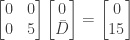
\begin{bmatrix} 0&0 \\ 0&5 \end{bmatrix} \begin{bmatrix} 0 \\ \bar{D} \end{bmatrix} = \begin{bmatrix} 0 \\ 15 \end{bmatrix}

We then have 5 \bar{D} = 15 or \bar{D} = 3.

So the least squares solution is the line b = 3t. This line passes through the origin (i.e., at t = 0 it has a value of zero). At time t_1 = 1 it has the value 3, which is greater than the value b_1 = 1. At time t_2 = 2 it has the value 6, which is less than the value b_2 = 7.

NOTE: This continues a series of posts containing worked out exercises from the (out of print) book Linear Algebra and Its Applications, Third Edition by Gilbert Strang.

If you find these posts useful I encourage you to also check out the more current Linear Algebra and Its Applications, Fourth Edition, Dr Strang’s introductory textbook Introduction to Linear Algebra, Fourth Edition and the accompanying free online course, and Dr Strang’s other books.

 Buy me a snack to sponsor more posts like this!

Posted in linear algebra | Tagged , | Leave a comment

Linear Algebra and Its Applications, Exercise 3.3.1

Exercise 3.3.1. a) Given the system of equations consisting of 3x = 10 and 4x = 5 find the least squares solution \bar{x} and describe the error E^2 being minimized by that solution. Confirm that the error vector \left(10-3\bar{x}, 5-4\bar{x}\right) is orthogonal to the column \left(3, 4\right).

Answer: This is a system Ax = b where A = \begin{bmatrix} 3 \\ 4 \end{bmatrix} and b = \begin{bmatrix} 10 \\ 5 \end{bmatrix}. We can then compute the least squares solution as \bar{x} = \left(A^TA\right)^{-1}A^Tb.

We have

A^TA = \begin{bmatrix} 3&4 \end{bmatrix} \begin{bmatrix} 3 \\ 4 \end{bmatrix} = 3 \cdot 3 + 4 \cdot 4 = 25

so that \left(A^TA\right)^{-1} = \frac{1}{25}. We then have

\bar{x} = \left(A^TA\right)^{-1}A^Tb = \frac{1}{25} \begin{bmatrix} 3&4 \end{bmatrix} \begin{bmatrix} 10 \\ 5 \end{bmatrix}

= \frac{1}{25} \left(3 \cdot 10 + 4 \cdot 5\right) = \frac{50}{25} = 2

So the least squares solution is \bar{x} = 2.

The error vector is then

b - A\bar{x} = \begin{bmatrix} 10 \\ 5 \end{bmatrix} - 2 \begin{bmatrix} 3 \\ 4 \end{bmatrix} = \begin{bmatrix} 4 \\ -3 \end{bmatrix}

and the corresponding error

E^2 = \|b-A\bar{x}\|^2 = \left(b-A\bar{x}\right)^T\left(b-A\bar{x}\right)

= \begin{bmatrix} 4&-3 \end{bmatrix} \begin{bmatrix} 4 \\ -3 \end{bmatrix} = 16 + 9 = 25

The inner product of the error vector b-A\bar{x} = \left(4, -3\right) and the column \left(3, 4\right) of A is 4 \cdot 3 - 3 \cdot 4 = 12 - 12 = 0. Since the inner product is zero the two vectors are orthogonal.

NOTE: This continues a series of posts containing worked out exercises from the (out of print) book Linear Algebra and Its Applications, Third Edition by Gilbert Strang.

If you find these posts useful I encourage you to also check out the more current Linear Algebra and Its Applications, Fourth Edition, Dr Strang’s introductory textbook Introduction to Linear Algebra, Fourth Edition and the accompanying free online course, and Dr Strang’s other books.

 Buy me a snack to sponsor more posts like this!

Posted in linear algebra | Tagged , | Leave a comment

Linear Algebra and Its Applications, Exercise 3.2.16

Exercise 3.2.16. a) Given the projection matrix P projecting vectors onto the line through a and two vectors x and y, show that the inner products of x with Py and y with Px are equal.

b) In general would the angles between x and a and y and a be equal to each other? If a = \left(1, 1, -1\right), x = \left(2, 0, 1\right), and y = \left(2, 1, 2\right) what are the cosines of the two angles?

c) Show that the inner product of Px and Py is the same as the inner products of x with Py and y with Px and explain why this is. What is the angle between the vectors Px and Py?

Answer: a) We have P = aa^T/a^Ta so that

Px = \left(aa^T/a^Ta\right)x = \frac{1}{a^Ta}\left(aa^Tx\right) = \frac{a^Tx}{a^Ta}a

and

Py = \left(aa^T/a^Ta\right)y = \frac{1}{a^Ta}\left(aa^Ty\right) = \frac{a^Ty}{a^Ta}a

The inner product of x with Py is then

x^T\left(Py\right) = x^T\left(a^Ty/a^Ta\right)a

= \left(a^Ty/a^Ta\right)x^Ta = \left(a^Tyx^Ta\right)/a^Ta

= \left(a^Tya^Tx\right)/a^Ta = \left(a^Txa^Ty\right)/a^Ta

and the inner product of y with Px is then

y^T\left(Px\right) = y^T\left(a^Tx/a^Ta\right)a

= \left(a^Tx/a^Ta\right)y^Ta = \left(a^Txy^Ta\right)/a^Ta

= \left(a^Txa^Ty\right)/a^Ta

So the inner products of x with Py and y with Px are equal.

b) Since x and y are arbitrary vectors, in general they would not make the same angle with respect to a. For example, consider the case when a = \left(1, 1, -1\right), x = \left(2, 0, 1\right), and y = \left(2, 1, 2\right).

If \theta_1 is the angle between x and a then \cos \theta_1 = a^Tx/\left(\|a\|\|x\|\right). Similarly, if \theta_2 is the angle between y and a then \cos \theta_2 = a^Ty/\left(\|a\|\|y\|\right)

In this case we have

a^Tx = 1 \cdot 2 + 1 \cdot 1 - 1 \cdot 2 = 2 + 1 - 2 = 1

a^Ty = 1 \cdot 2 + 1 \cdot 0 - 1 \cdot 1 = 2 + 0 - 1 = 1

\|a\| = \sqrt{1^2 + 1^2 + \left(-1\right)^2} = \sqrt{1 + 1 + 1} = \sqrt{3}

\|x\| = \sqrt{2^2 + 0^2 + 1^2} = \sqrt{4 + 0 + 1} = \sqrt{5}

\|y\| = \sqrt{2^2 + 1^2 + 2^2} = \sqrt{4 + 1 + 4} = \sqrt{9} = 3

So \cos \theta_1 = \frac{1}{\sqrt{3}\sqrt{5}} = \frac{1}{\sqrt{15}} and \cos \theta_2 = \frac{1}{\sqrt{3} \cdot 3} = \frac{1}{3\sqrt{3}}. The two cosines are different and thus \theta_1 and \theta_2 are not equal to each other.

c) As noted above we have Px = \frac{a^Tx}{a^Ta}a and Py = \frac{a^Ty}{a^Ta}a. Their inner product is then

\left(Px\right)^T\left(Py\right) = \left(\frac{a^Tx}{a^Ta}a\right)^T \left(\frac{a^Ty}{a^Ta}a\right)

\frac{a^Tx}{a^Ta} \frac{a^Ty}{a^Ta} \left(a^Ta\right) = \left(a^Txa^Ty\right)/a^Ta

But this is the same as the inner products x^TPy and y^TPx of x with Py and y with Px respectively.

This can be understood geometrically as follows: The vector x can be thought of as consisting of two components p_x and q_x where p_x is the projection of x onto a and q_x is the projection of x onto the vector b that is orthogonal to a. The inner product between x and Py is then

\left(Py\right)^Tx = \left(Py\right)^T\left(p_x+q_x\right)

= \left(Py\right)^Tp_x + \left(Py\right)^Tq_x

But p_x is simply Px. Also, since Px is a projection on a and q_x is a projection onto b their inner product is zero since a is orthogonal to b. We therefore have \left(Py\right)^Tx = \left(Py\right)^T\left(Px\right).

Similarly the vector y can be thought of as consisting of two components p_y = Py parallel to a and q_y orthogonal to a, with the inner product between y and Px then being

\left(Px\right)^Ty = \left(Px\right)^T\left(p_y+q_y\right)

= \left(Px\right)^Tp_y + \left(Px\right)^Tq_y

= \left(Px\right)^TPy = \left(Py\right)^TPx

We thus have \left(Py\right)^Tx = \left(Py\right)^TPx = \left(Px\right)^Ty.

Since Px and Py are both projections onto a the angle between them is zero.

NOTE: This continues a series of posts containing worked out exercises from the (out of print) book Linear Algebra and Its Applications, Third Edition by Gilbert Strang.

If you find these posts useful I encourage you to also check out the more current Linear Algebra and Its Applications, Fourth Edition, Dr Strang’s introductory textbook Introduction to Linear Algebra, Fourth Edition and the accompanying free online course, and Dr Strang’s other books.

 Buy me a snack to sponsor more posts like this!

Posted in linear algebra | Tagged , | Leave a comment

Linear Algebra and Its Applications, Exercise 3.2.15

Exercise 3.2.15. For a matrix A show that if AA^T = A^TA then the length of Ax is equal to the length of A^Tx for all x.

Answer: We have \|A^Tx\|^2 = \left(A^Tx\right)^T\left(A^Tx\right). By the rule for transposes of products we have \left( A^Tx \right)^T = x^T \left(A^T \right)^T =x^TA so that \|A^Tx\|^2 = x^TAA^Tx. But since we assumed that AA^T = A^TA we then have

\|A^Tx\|^2 = x^TAA^Tx = x^TA^TAx

Applying the rule for transposes of products once more we have x^TA^T = \left(Ax\right)^T so that

\|A^Tx\|^2 = \left(Ax\right)^T\left(Ax\right) = \|Ax\|^2

So the length of Ax is equal to the length of A^Tx.

NOTE: This continues a series of posts containing worked out exercises from the (out of print) book Linear Algebra and Its Applications, Third Edition by Gilbert Strang.

If you find these posts useful I encourage you to also check out the more current Linear Algebra and Its Applications, Fourth Edition, Dr Strang’s introductory textbook Introduction to Linear Algebra, Fourth Edition and the accompanying free online course, and Dr Strang’s other books.

 Buy me a snack to sponsor more posts like this!

Posted in linear algebra | Tagged , | Leave a comment

Linear Algebra and Its Applications, Exercise 3.2.14

Exercise 3.2.14. In \mathbb{R}^3 the planes corresponding to the equations x+y+t =0 and x-t=0 intersect in a line. What is the projection matrix P that projects points in \mathbb{R}^3 onto that line?

Answer: To find the line of intersection we solve the system of equations Av = 0 where

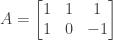
A = \begin{bmatrix} 1&1&1 \\ 1&0&-1 \end{bmatrix}

We use Gaussian elimination, subtracting 1  times row 1 from row 2 to produce the echelon matrix

U = \begin{bmatrix} 1&1&1 \\ 0&-1&-2 \end{bmatrix}

Since U has pivots in columns 1 and 2 we have x and y as basic variables and t as a free variable. Setting t=1 from the second row of U we have -y-2t = -y-2 =0 or y = -2. From the first row of U we then have x+y+t = x -2 +1 = 0 or x = 1. So \left(1, -2, 1 \right) is a solution to the system, as is any other vector on the line through the origin and \left(1, -2, 1 \right).

The projection matrix projecting points in \mathbb{R}^3 onto the line through v = \left(1, -2, 1 \right) is then

P = vv^T/v^Tv = \frac{1}{1 + 4 +1} \begin{bmatrix} 1 \\ -2 \\ 1 \end{bmatrix} \begin{bmatrix} 1&-2&-1 \end{bmatrix}

= \frac{1}{6} \begin{bmatrix} 1&-2&1 \\ -2&4&-2 \\ 1&-2&-1 \end{bmatrix} = \begin{bmatrix} \frac{1}{6}&-\frac{1}{3}&\frac{1}{6} \\ -\frac{1}{3}&\frac{2}{3}&-\frac{1}{3} \\ \frac{1}{6}&-\frac{1}{3}&\frac{1}{6} \end{bmatrix}

NOTE: This continues a series of posts containing worked out exercises from the (out of print) book Linear Algebra and Its Applications, Third Edition by Gilbert Strang.

If you find these posts useful I encourage you to also check out the more current Linear Algebra and Its Applications, Fourth Edition, Dr Strang’s introductory textbook Introduction to Linear Algebra, Fourth Edition and the accompanying free online course, and Dr Strang’s other books.

 Buy me a snack to sponsor more posts like this!

Posted in linear algebra | Tagged | 1 Comment

Linear Algebra and Its Applications, Exercise 3.2.13

Exercise 3.2.13. For a projection matrix P = aa^T/a^Ta show that the sum of the diagonal entries of P (the “trace” of P) always equals one.

Answer: For a = \left( a_1, a_2, \dots, a_n \right) the diagonal entries of P = aa^T/a^Ta are a_1^2 / (a^Ta), a_2^2 / (a^Ta), through a_n^2 / (a^Ta) so that the trace of P is

\left( a_1^2 + a_2^2 + \cdots + a_n^2 \right) / (a^Ta) = a^Ta / (a^Ta) = 1

UPDATE: Corrected the formulas for the diagonal entries of P.

NOTE: This continues a series of posts containing worked out exercises from the (out of print) book Linear Algebra and Its Applications, Third Edition by Gilbert Strang.

If you find these posts useful I encourage you to also check out the more current Linear Algebra and Its Applications, Fourth Edition, Dr Strang’s introductory textbook Introduction to Linear Algebra, Fourth Edition and the accompanying free online course, and Dr Strang’s other books.

 Buy me a snack to sponsor more posts like this!

Posted in linear algebra | Tagged , | Leave a comment

Linear Algebra and Its Applications, Exercise 3.2.12

Exercise 3.2.12. Find a projection matrix P that projects every vector in \mathbb{R}^2 onto the line described by the equation x+2y=0.

Answer: One solution to the equation x+2y=0 is a = \left( -2, 1 \right). The projection matrix that projects vectors onto the line through a is

P = aa^T/a^Ta = \frac{1}{-2 \cdot -2 + 1 \cdot 1} \begin{bmatrix} -2 \\ 1 \end{bmatrix}\begin{bmatrix} -2&1 \end{bmatrix}

= \frac{1}{5} \begin{bmatrix} 4&-2 \\ -2&1 \end{bmatrix} = \begin{bmatrix} \frac{4}{5}&-\frac{2}{5} \\ -\frac{2}{5}&\frac{1}{5} \end{bmatrix}

NOTE: This continues a series of posts containing worked out exercises from the (out of print) book Linear Algebra and Its Applications, Third Edition by Gilbert Strang.

If you find these posts useful I encourage you to also check out the more current Linear Algebra and Its Applications, Fourth Edition, Dr Strang’s introductory textbook Introduction to Linear Algebra, Fourth Edition and the accompanying free online course, and Dr Strang’s other books.

 Buy me a snack to sponsor more posts like this!

Posted in linear algebra | Tagged | Leave a comment

Linear Algebra and Its Applications, Exercise 3.2.11

Exercise 3.2.11. a) Given the line through the origin and a = \left( 1, 3 \right) find the matrix P_1 that projects onto this line, as well as the matrix P_2 that projects onto the line perpendicular to the original line.

b) What is P_1 + P_2? What is P_1P_2? Explain your answers.

Answer: a) We have

P_1 = aa^T/a^Ta = \frac{1}{1^2 + 3^2} \begin{bmatrix} 1 \\ 3 \end{bmatrix}\begin{bmatrix} 1&3 \end{bmatrix} = \frac{1}{10} \begin{bmatrix} 1&3 \\ 3&9 \end{bmatrix}

We next find the perpendicular line. If this line passes through the origin and b = \left(b_1, b_2 \right) then we will have b orthogonal to a so that a^Tb = a_1b_1 + a_2b_2 = b_1 + 3b_2 = 0. One vector satisfying this condition is b = \left( -3, 1 \right). We then have

P_2 = bb^T/b^Tb = \frac{1}{(-3)^2 + 1^2} \begin{bmatrix} -3 \\ 1 \end{bmatrix}\begin{bmatrix} -3&1 \end{bmatrix} = \frac{1}{10} \begin{bmatrix} 9&-3 \\ -3&1 \end{bmatrix}

b) Taking the product of the two projection matrices first, we have

P_1P_2 = \frac{1}{10} \begin{bmatrix} 1&3 \\ 3&9 \end{bmatrix} \frac{1}{10} \begin{bmatrix} 9&-3 \\ -3&1 \end{bmatrix}

= \frac{1}{100} \begin{bmatrix} 9-9&-3+3 \\ 27-27&-9+9 \end{bmatrix} = \frac{1}{100} \begin{bmatrix} 0&0 \\ 0&0 \end{bmatrix} = 0

This true because multiplying a vector by P_2 projects it onto the line through b, and multiplying by P_1 projects the resulting vector onto the line through a. But because b is perpendicular to a in multiplying by P_1 all points on the line through b get projected onto the origin.  The effect of multiplying by the product matrix P_1P_2 is thus the same as multiplying by zero. (Note also that P_2P_1 = 0 for the same reason.)

Taking the sum of the two projection matrices, we have

P_1 + P_2 = \frac{1}{10} \begin{bmatrix} 1&3 \\ 3&9 \end{bmatrix} + \frac{1}{10} \begin{bmatrix} 9&-3 \\ -3&1 \end{bmatrix}

= \frac{1}{10} \begin{bmatrix} 1+9&3-3 \\ 3-3&9+1 \end{bmatrix} = \frac{1}{10} \begin{bmatrix} 10&0 \\ 0&10 \end{bmatrix}

= \begin{bmatrix} 1&0 \\ 0&1 \end{bmatrix} = I

In other words, multiplying a vector by the sum of the two projection matrices results in the same vector:

(P_1+P_2)v = P_1v + P_2v = v

In effect we have transformed the vector v into two perpendicular component vectors: one component P_1v on the line through a and a second component P_2v on the perpendicular line through b. Adding the components back together reconstitutes the original vector.

UPDATE: Corrected the calculations above to include the factors 1/a^Ta and 1/b^Tb when calculating the projection matrices. Thanks go to Trystyn for catching my original error.

NOTE: This continues a series of posts containing worked out exercises from the (out of print) book Linear Algebra and Its Applications, Third Edition by Gilbert Strang.

If you find these posts useful I encourage you to also check out the more current Linear Algebra and Its Applications, Fourth Edition, Dr Strang’s introductory textbook Introduction to Linear Algebra, Fourth Edition and the accompanying free online course, and Dr Strang’s other books.

 Buy me a snack to sponsor more posts like this!

Posted in linear algebra | Tagged , | 2 Comments

Linear Algebra and Its Applications, Exercise 3.2.10

Exercise 3.2.10. Discuss whether the projection matrix P from exercise 3.2.9 is invertible or not. Explain your answer.

Answer:The projection matrix

P = aa^T/a^Ta = \frac{1}{a_1a_1 + a_2a_2 + \dots + a_na_n} \begin{bmatrix} a_1 \\ a_2 \\ \vdots \\ a_n \end{bmatrix}\begin{bmatrix} a_1&a_2&\dots&a_n \end{bmatrix}

= \frac{1}{a_1a_1 + a_2a_2 + \dots + a_na_n} \begin{bmatrix} a_1 \cdot a_1&a_1 \cdot a_2&\cdots&a_1 \cdot a_n \\ a_2 \cdot a_1&a_2 \cdot a_2&\cdots&a_2 \cdot a_n \\ \vdots&\vdots&\ddots&\vdots \\ a_n \cdot a_1&a_n \cdot a_2&\cdots&a_n \cdot a_n \end{bmatrix}

Note that each column i of the resulting matrix is equal to the original vector a = \left(a_1, a_2, \dots, a_n \right) multiplied by a scalar factor equal to a_i/a^Ta. The columns are therefore linearly dependent with each of them expressible as the first column times the factor a_i/a_1, and thus the rank of the projection matrix P is r = 1. Since the rank r < n the matrix P is singular and not invertible.

Also note that this is consistent with the geometry of the situation: Since P projects vectors from a higher-dimensional vector space onto a line, many points in the space will end up being mapped into a single point on a line. There is thus no way to reverse the mapping and map a point on the line onto a single unique vector in the higher-dimensional space.

NOTE: This continues a series of posts containing worked out exercises from the (out of print) book Linear Algebra and Its Applications, Third Edition by Gilbert Strang.

If you find these posts useful I encourage you to also check out the more current Linear Algebra and Its Applications, Fourth Edition, Dr Strang’s introductory textbook Introduction to Linear Algebra, Fourth Edition and the accompanying free online course, and Dr Strang’s other books.

 Buy me a snack to sponsor more posts like this!

Posted in linear algebra | Tagged , | Leave a comment

Linear Algebra and Its Applications, Exercise 3.2.9

Exercise 3.2.9. Consider the projection matrix P = aa^T/a^Ta that projects onto a line. Show that P^2 = P.

Answer: Note that a^Ta is a scalar (the inner product of a with itself) and aa^T is a matrix. We have

P^2 = \left(aa^T/a^Ta\right)^2 = \left(1/a^Ta\right)^2 \left(aa^T\right)^2

= \left(1/a^Ta\right)^2 \left(aa^Taa^T\right) = \left(1/a^Ta\right)^2 a\left(a^Ta\right)a^T

= \left(1/a^Ta\right)^2 \left(a^Ta\right)aa^T = \left(1/a^Ta\right) aa^T

= aa^T/a^Ta = P

NOTE: This continues a series of posts containing worked out exercises from the (out of print) book Linear Algebra and Its Applications, Third Edition by Gilbert Strang.

If you find these posts useful I encourage you to also check out the more current Linear Algebra and Its Applications, Fourth Edition, Dr Strang’s introductory textbook Introduction to Linear Algebra, Fourth Edition and the accompanying free online course, and Dr Strang’s other books.

 Buy me a snack to sponsor more posts like this!

Posted in linear algebra | Tagged , , , | Leave a comment